Google is changing how Android apps get installed.
A countdown clock says your Android phone is about to be locked down. Here is what Google's new app verification actually changes, and what it does not.

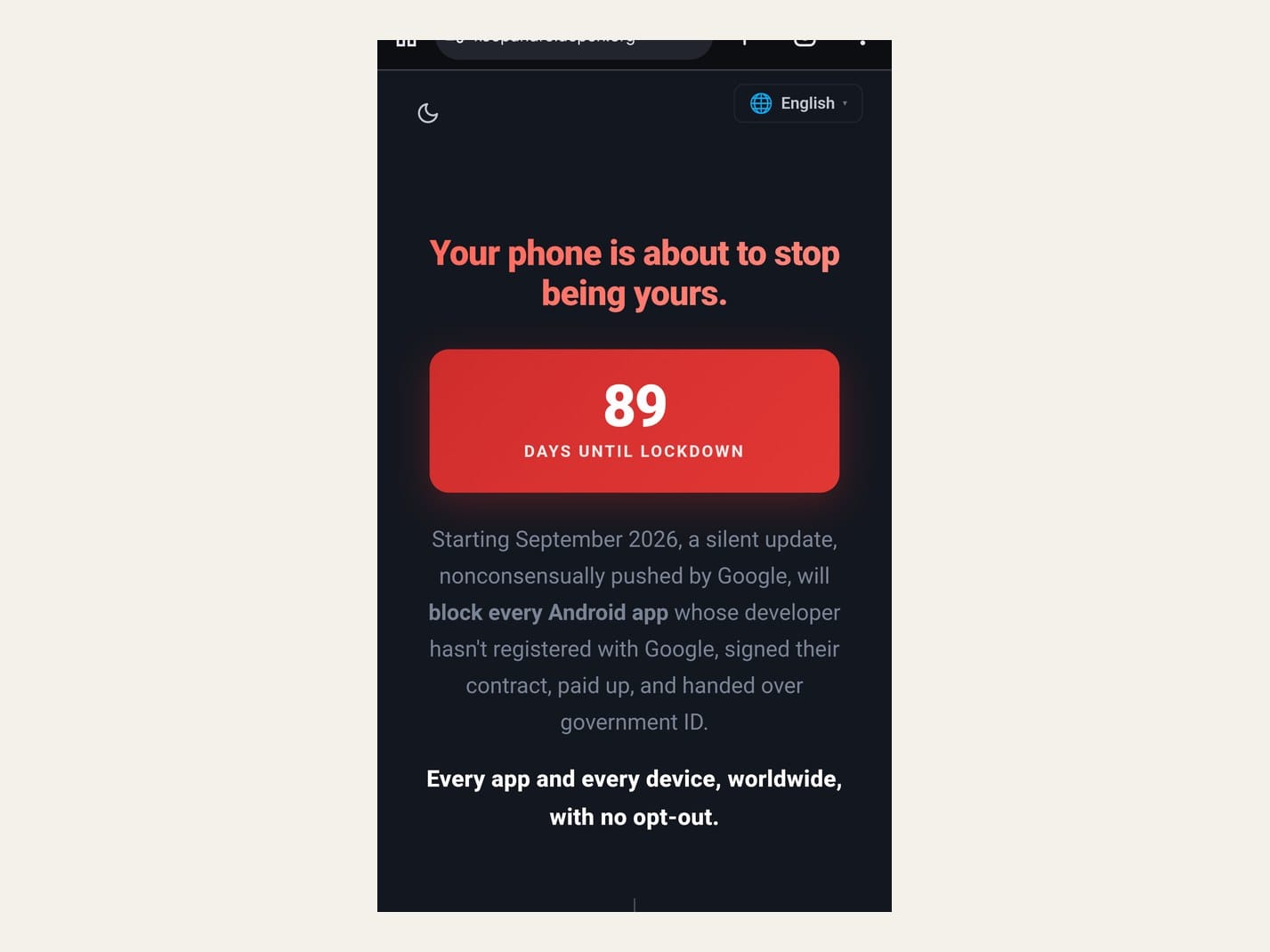
A countdown clock is going around online, and it has people rattled. It says "89 days until lockdown." It says "your phone is about to stop being yours." Here is what is happening.
Starting later this year, an app will only install on most Android phones if the person who built it has registered a verified identity with Google. That includes apps you install from outside the Play Store, a process called sideloading, which never needed Google's sign-off before. It is a real change. For most people, the alarm is overblown.
Verification means Google confirms who made an app before it installs. Google is not reading your apps or judging what they do. It is checking that a real, named person or company stands behind each one. A developer registers a legal name, address, email, and phone number, and sometimes a government ID. The full account costs a one-time $25.
Enforcement starts September 30, and only in four countries: Brazil, Indonesia, Singapore, and Thailand. The wider rollout does not begin until 2027. If you are in the United States, nothing on your phone changes this year, and the apps you already use keep installing the same as always. The countdown clock skips all of that. It presents the change as every app, every phone, worldwide, tomorrow, which is the version to be skeptical of.
There are two ways around the ID check. A power user can still sideload from an unverified developer through what Google calls an "advanced flow," a deliberately slow path: turn on developer mode, confirm nobody is coaching you, restart, and wait a day. A hobbyist who just wants to share an app with friends or a class can get a free account that skips the ID check, capped at 20 devices. The old tool for installing apps over a USB cable is untouched too.
Google's reason is malware. Its own analysis found over 50 times as much malware coming from sideloaded apps as from the Play Store. The four countries going first are the ones hit hardest by fake banking apps and app-based scams. That is a genuine problem. Putting a name behind every app makes it harder for the same bad actor to keep rebuilding after a takedown. It is the same fraud world we covered when police took down a major pop-up scam operation.
For most people in the United States, the countdown is noise. You are not losing access to your phone in three months. For your phone, this lands as a malware guardrail you will probably never notice. Where it does land is on the people who build and distribute apps.
The friction lands on developers. Google would become the identity checkpoint for who is allowed to offer software to about 95 percent of the world's Android phones outside China. Most developers will register and move on. The ones raising the alarm are the ones who cannot easily pass that checkpoint. Open-source projects like F-Droid sign apps in a way that does not fit Google's one-name-per-app requirement. Independent developers may have real privacy reasons not to hand Google a government ID.
There is a reason this stings for some Android users. A lot of people chose Android on purpose, to stay out of the walled garden Apple built, where the platform owner decides what you are allowed to install. This policy moves Android a step in that direction. I lean toward open myself. The more a device belongs to the person holding it, the better.
But I understand this change. The malware is real, the countries going first are getting hammered, and for the large majority of people the change will pass by unnoticed. Both things are true at once: it is a reasonable answer to a real problem, and it hands one company more say over the ecosystem that was supposed to be the open alternative.
Google keeps holding up that "advanced flow" as proof the platform stays open. As of this summer, a coalition of more than 70 groups fighting the policy, including the Electronic Frontier Foundation and the Tor Project, says the advanced flow has not shown up in a single test build of Android. It exists as a blog post and some mockups. The escape hatch everyone is being told to trust has not been built anywhere it can be tested.
If you use a typical US Android phone, nothing here is urgent. A few things still make sense:
- Ignore the countdowns. Nothing changes on your US phone in 2026, so do not let a clock rush you into anything.
- Keep installing from the Play Store for now. By Google's own numbers that is where the least malware is, and it is unaffected either way.
- Be suspicious of anyone who phones you and talks you through installing an app, especially one from outside the store. That walk-you-through-it move is the scam this policy is built to slow down.
- If you lean on F-Droid or another third-party app store, keep an eye on the 2027 rollout. That is when the real effect reaches the US.
I use Android. I am not panicked, and you do not need to be either. The malware problem is real, and Google's fix will probably help. The open question is whether one company should hold the only key to that door, and whether the way around it that we have all been promised ever gets built.
Sources
- Google, "A new layer of security for certified Android devices" (Android Developers Blog, August 2025)
- Android Developers, "Balancing openness and choice with safety" (March 2026)
- The Hacker News, "Google Sets Sept. 30 Deadline for Android Developer Verification" (June 2026)
- Keep Android Open, the campaign behind the countdown