What a Flock camera actually does
It photographs every car that passes, including yours. The argument your city council is having is about who gets to search the record.

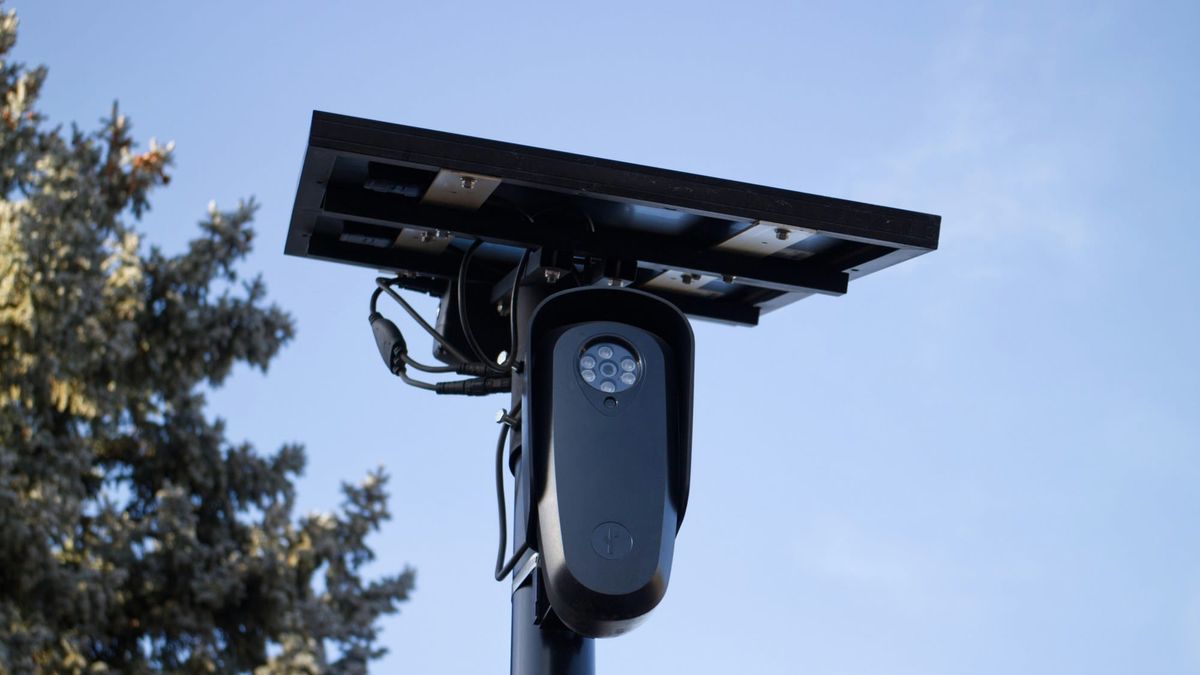
You have probably driven past one. A small black box on a pole, eight or ten feet up, often with a little solar panel bolted alongside it. No wires running anywhere. Most of us saw it once, figured it was a speed camera, and never thought about it again.
But speed has nothing to do with it.
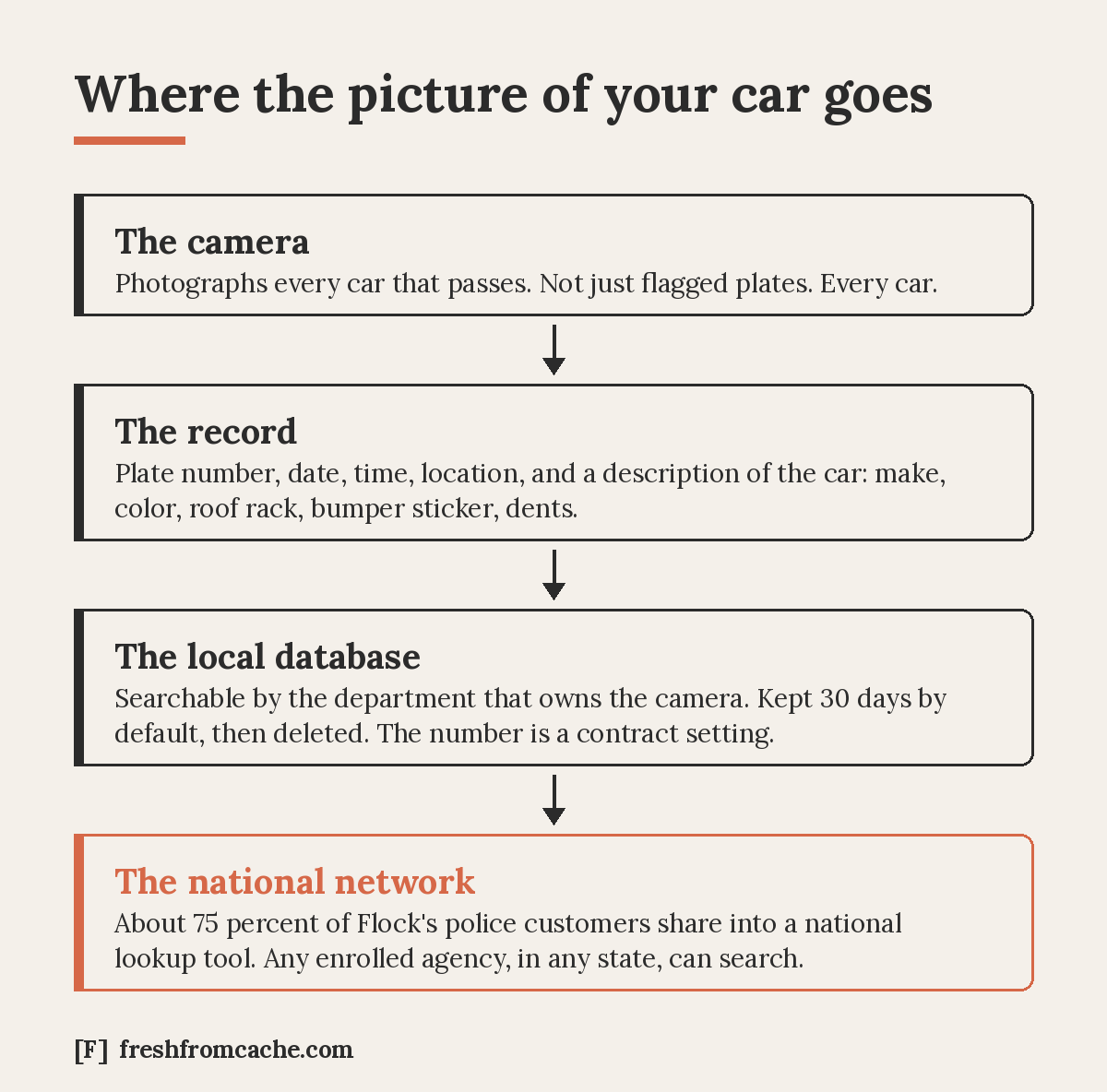
That box is an automatic license plate reader, usually shortened to ALPR, and the company behind most of the ones you see is Flock Safety. It photographs every car that goes by. Software reads the plate off the photo. It saves the plate number, the date, the time, the location, and a description of the car. It then uploads all of it to a database your police department can search.
It's really that simple. A logging machine on a pole. The argument the city council has been having is about who gets to search the log.
What it records
The plate is the obvious part. But wait, there's more.
Along with the number, the system records what Flock calls a vehicle fingerprint. The fingerprint includes:
- Make
- Model
- Color
- The state the plate was issued in
- Whether the plate is missing or covered
Additionally it collects features that make your car yours. A roof rack. A bumper sticker. The dent you keep meaning to fix but haven't.
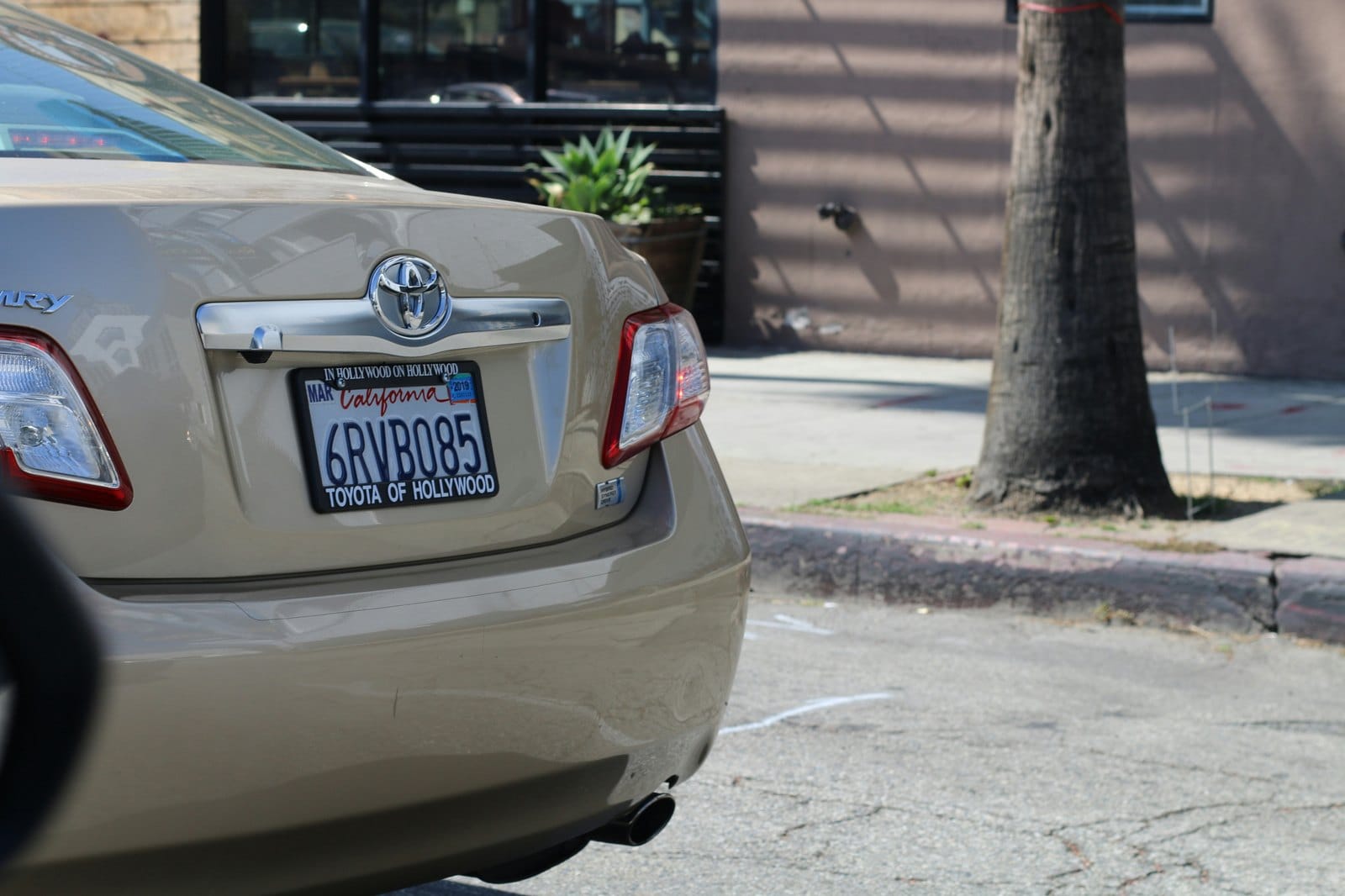
It does not record faces. Flock says its plate readers do not use facial recognition and cannot identify people. The company also sells a separate video line that does detect people, which is a different device with a different set of concerns attached to it.
By default the pictures and the records are kept for 30 days, then deleted automatically. That number is a contract setting, so it's not set in stone. Flagstaff, Arizona cut theirs to 14 days. Washington and Virginia now cap it by law at 21. An agency can also ask to keep records longer.
Thirty days does not sound like much until you think about what 30 days of your own driving would show. Your car already generates a private trail of its own (your car grades your driving); this one is bolted to public infrastructure, and nobody asked you to agree to a terms of service.
How the searching works
The searching of this information is done in three ways.
The first is a hot list alert. A plate tied to a stolen car or an arrest warrant passes a camera, and an officer's in-car computer pings in real time. That one is aimed at a specific plate.
The second is a lookup. An officer types in a plate and sees everywhere that car was photographed inside the retention window. That one is aimed at a specific car, after the fact.
The third is the National Lookup Tool. An agency that shares its own camera data can search the camera data of every other agency that shares. Flock told Senator Ron Wyden that about 75 percent of its law enforcement customers are enrolled. So a search run in another state can bring up the picture of your car taken two blocks from your house.
Every search does require the officer to type a reason. Which is just a free text field.
What it is good at
There is some good that has come from the Flock cameras.
Flock says its cameras helped recover six abducted children in Colorado over five months, five of them tied to AMBER Alerts. In one Aurora case officers found a 14-month-old in under ten minutes. Stolen car searches are the everyday use. Nationally, only about 9 percent of car thefts are ever cleared, the lowest rate of any major crime category. Departments running these camera reports are finding vehicles they otherwise may not have.
The Los Angeles Police Department's own audit is a good measure, because LAPD is the department that just canceled their Flock contract. In two months, plate reader data helped recover 337 stolen vehicles and contributed to 74 felony arrests.
That is the trade off.
Where it goes wrong
The same LAPD audit is why the department let its Flock contract lapse on July 11.
The Inspector General reviewed August 1 to September 30 of 2025. In that window the cameras took more than 210 million pictures of plates and generated 498 stolen-vehicle alerts. Of those, 161 were correct readings of cars that turned out not to be stolen. About one alert in three sent officers after an innocent driver.
These cameras were not misreading the plates. The lists behind the plates were stale. The lists include recovered cars that never cleared from the system and typos in the original report. The camera did its job perfectly, but it handed out incorrect information to the police.
That matters because a stolen-vehicle stop is handled as high risk. Backup, a supervisor, the driver ordered out of the car, guns drawn. The Institute for Justice has documented at least 27 cases of innocent drivers pulled over, held at gunpoint, or jailed on bad plate-reader hits. In Sherwood, Arkansas this February, a couple was taken out of their car at gunpoint while their six-week-old sat in the back seat.
Who else is searching?
Mountain View, California found out through a public records request that a statewide sharing setting had been left on for 29 of its 30 cameras for 17 months. In that time more than 250 agencies that had never signed an agreement with the city ran about 600,000 searches. The city said Flock enabled a nationwide setting without its knowledge and called it a system failure on the company's part. Flock's position is that sharing settings are always under the agency's control. Mountain View turned every camera off in February.
Then there is the thread that has driven most of the national coverage. The outlet 404 Media obtained one Illinois department's search logs and found more than 4,000 statewide and national lookups run between June 2024 and May 2025 either at the request of federal agents or with an immigration-related reason typed in the box. Immigration and Customs Enforcement holds no contract with Flock. It reached the data through local and state police who do. Flock has since pulled some states out of the national tool and added keyword filters. However, Senator Wyden and the ACLU point out that the reason field is still free text, so a filter is easy to work around.
There is also plain misuse, and here the company and its critics mostly agree on the facts. The Institute for Justice counts at least 24 cases of officers using plate readers to track romantic partners and exes. A police chief in Sedgwick, Kansas ran his ex-girlfriend more than 200 times before he resigned. Flock says a new audit feature is what flagged several of those searches, and that the technology did not create the misuse, people did. Both statements can be true, but the disagreement is about whose job it is to catch the misuse.
Does my town have these?
Four ways to find out, easiest first.
- Check the map. A crowdsourced project called DeFlock maps reported cameras at deflock.me, including which way each one faces. It is volunteer-built and incomplete, so a blank spot is not proof.
- Look for a transparency portal. Some departments publish one with basic search statistics. Not all do.
- Read the council minutes. These contracts usually pass at a regular meeting with a thin crowd. The site ALPR.watch tracks upcoming agendas.
- File a records request with the police department, not with Flock. The department holds the data. Ask for the contract, the retention setting, and the sharing logs.
Locally, in Oregon, a lot has moved. Bend ended its pilot early in January. Eugene, Springfield, Albany, Woodburn, and the Lane County Sheriff have turned cameras off or pulled them out. As of last November the ACLU of Oregon had confirmed Flock use in at least ten counties and had not confirmed any in Multnomah County. Portland police use a different vendor.
Both states also wrote rules this year. Oregon's SB 1516 requires deleting images after 30 days unless they are tied to an investigation, limits out-of-state access, and requires an officer to log and justify every search. Washington's SB 6002 took effect March 30 and goes further: 21 days, a short list of crimes the system may be used for, and no cameras near schools, clinics, or places of worship.
What you can do about your own car
Not much.
There is no opt-out and no delete button. Flock's position is that the agency owns the data. When a California resident filed a deletion request under state privacy law, the company sent them to the police department.
Do not cover your plate. Florida banned frames, covers, and sprays outright last October, and most states already had similar rules. An obscured plate is its own reason to get pulled over. You'd be trading a database entry for a traffic stop.
What actually works is local. These cameras arrive by contract and leave by contract. Every one of the towns above got there through a council vote.

Pull up the map first. If your town has them, there are two questions to ask at the next meeting: how long the pictures are kept, and whether the national sharing is turned on. Neither one should be a mystery. Both are settings somebody has to choose.
Sources
- 404 Media on the LAPD Office of the Inspector General ALPR audit (July 2026)
- Institute for Justice, wrongful-stop analysis and officer-misuse analysis (updated July 2026)
- 404 Media, Flock search-log reporting (May 2025)
- Senator Ron Wyden, letter to Flock Safety (PDF, 2025)
- Flock Safety, license plate reader policy
- Washington SB 6002 (MRSC summary) and Oregon SB 1516 (KLCC)