Most teen safety features don't work. Here's what does.
An independent audit tested 86 safety features across TikTok, Instagram, Snapchat, and YouTube. Most failed. These are the ones worth turning on, and the ones you can skip.

If you set up a "teen account" for your kid, flipped on a couple of safety settings, and figured you'd handled it, this article is going to sting a little. A team of researchers spent seven months testing 86 safety features these apps advertise, across TikTok, Instagram, Snapchat, and YouTube. Only 35 both worked the way the company claimed and were easy enough for a regular person to find and use.
That number made headlines, but a smaller finding is worse. On a test account set up as a minor, after it searched a few things about eating disorders and self-harm, TikTok stopped blocking those searches and started suggesting them. The terms it served to that child's account included tips for hiding food and phrases about self-harm. The researchers didn't go looking for those. The app recommended them.
So before you trust the parental control switches, it helps to know which ones actually do something.
Who ran it, and who paid for it
The report is called "Broken, Buried, or Missing." It came out June 29 from the Cybersafety Research Center, a joint project of NYU and Northeastern. The team behind it has real credentials: it includes Arturo Béjar, the former Meta engineer who testified to Congress in 2023 about the harm teens were facing on Instagram, and Laura Edelson, a Northeastern researcher who has spent years auditing how big platforms actually work.
Two things about the study belong up front. It was produced with support from the Heat Initiative, an advocacy group that campaigns against these companies, and it has not been through peer review. The platforms also make a fair point in response: the test deliberately left out the parental controls that parents set up themselves. Additionally, some of the failures came from researchers actively trying to break a protection rather than from ordinary use.
Both of those are true, but neither one explains away the core finding. The worst failures happened during normal use. A kid searching didn't have to try anything clever to get TikTok to suggest self-harm terms. Misspelling "eating disorder" by one letter got past Instagram's filter. The anti-bullying prompt that is supposed to ask a user to reconsider a cruel comment never once fired.
How they tested
The method was straightforward. Real test accounts, some set up as kids aged 13 to 17, some as adults. Three situations: a child using the app normally, a teen trying to get around a restriction on their own account, and an adult trying to get around the protections on a child's account. A feature counted as a pass only if it did what the company said AND a regular person could actually find it and turn it on. Everything else got sorted into broken, buried (real, but hidden), or missing (couldn't get it to work at all).
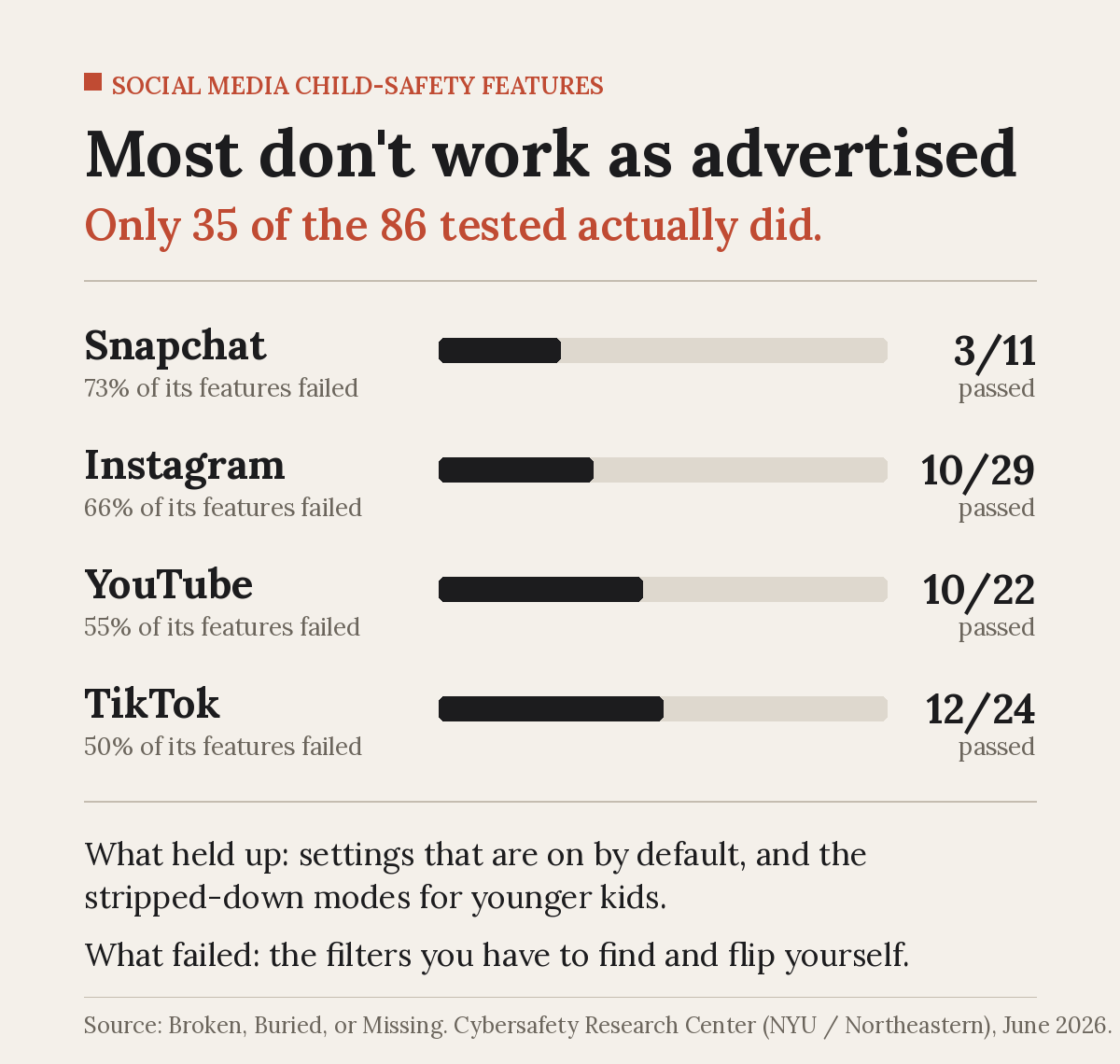
By that bar, Instagram passed 10 of 29. Snapchat passed 3 of 11. YouTube passed 10 of 22. TikTok passed the most, 12 of 24.
What actually works
There is a useful pattern under all of it. The protections that held up almost all fall into two groups: the ones that are ON by default, and the ones that take the risky thing away entirely for younger kids. The switches you have to hunt for and flip yourself are the ones that mostly failed.
So, the ones to rely on. Same thing at a glance, then the details underneath.
Instagram passed 10 of 29
Turn on Private by default, no Live, block / mute / restrict, and adults can't message your teen first.
Skip Anti-bullying prompts and word filters. Note: if your teen messages an adult first, that opens the door back up.
Snapchat passed 3 of 11
Turn on Blocking, and location sharing off.
Skip Screen-time limits (it has none) and the stranger-contact protections. This is the app with the highest stranger risk.
TikTok passed 12 of 24
Turn on For kids under 13, the “Younger Users” mode. For teens, the account-level controls.
Skip The self-harm and eating-disorder search filter.
YouTube passed 10 of 22
Turn on Autoplay off, no save-to-watch-later, sign-in for age-restricted content, and YouTube Kids for younger kids.
Skip The in-app screen-time reminder.
Instagram. Teen accounts are private by default, and that default held. Your teen can't go live. Blocking, muting, and restricting an account all work. Adults can't start a conversation with a teen who doesn't follow them. One honest catch on that last one: if your teen messages an adult first, the adult can message back with no restriction, even with no follow between them. So the "adults can't contact my kid" protection has a door in it that your kid can open.
Snapchat. Blocking works, and turning off location sharing (so your kid isn't broadcasting where they are on the map) works. That is most of the good news. Snapchat had no working screen-time feature at all. This is the app where researchers, from a plain adult account, found a child's account and messaged it with nothing in the way. The stranger-contact protections it advertises did not hold up. Treat Snapchat as the app where that risk is highest.
TikTok. For kids under 13, "TikTok for Younger Users" is the single strongest protection in the whole report. It strips the app down to a view-only, curated mode. No open search, no direct messages, no endless algorithmic feed, and a one-hour daily limit that is actually enforced. If you have a younger child on TikTok, that mode is the mode to use. For teenagers, TikTok's account-level controls (private account, who can message, who can duet) work reasonably well. Its search filter, the one that is supposed to block self-harm and eating-disorder content, does not. Don't count on it.
YouTube. For younger kids, YouTube Kids is the separate, stripped-down app, same idea as TikTok's under-13 mode. On regular YouTube, three settings genuinely work and are worth turning on: turn off autoplay so one video doesn't roll into six hours, the setting that stops kids saving videos to watch later, and forcing sign-in for age-restricted content. Its in-app screen-time reminder, though, is one tap to dismiss.
What you can skip
These are the ones you can stop trusting, because the report found them broken, hidden, or missing across the board.
The in-app search filters for self-harm and eating-disorder content. Bypassable in under three minutes on every platform, and on TikTok worse than useless.
The in-app screen-time reminders. Every one of them can be tapped away. YouTube's even links straight to the off switch.
The anti-bullying "are you sure you want to post this" prompts. They didn't fire.
Word and comment filters. Swapping a few letters for numbers walked right past them.
Looking through these settings is still time well spent. Turn on the ones that work. Just don't mistake having flipped a switch for having covered the risk.
One caveat on all of this. These are the results as of June 2026, and platforms change their settings. A switch that failed the test could be fixed later, and one that passed could change. Re-check the ones that matter to you every few months.
The controls that don't live in the apps
The stronger layer isn't inside these apps. It is on the phone and in the house.
Set the screen-time limit at the device level, not in the app. Apple's Screen Time (through Family Sharing) and Google's Family Link let you set a limit the kid can't just tap away, which the in-app timers can't do. The platforms said as much in their own defense. Two honest limits: independent testers in Germany found kids getting around Apple's limits through an accessibility feature, and Family Link's controls only have teeth for kids under 13. At 13, Google hands much of that control back. So these help, but nothing here is a lock.
The American Academy of Pediatrics points parents to a written family media plan and house rules that don't depend on application controls: no phones in bedrooms overnight, charge devices somewhere other than the nightstand, screens off at meals. Common Sense Media says much the same, adds turning on SafeSearch, and suggests monitoring apps like Bark or Qustodio for older teens, used openly with your kid rather than behind their back. The through-line is that the conversation does more work than the controls.
Looking forward
The ground under all of this is moving. This spring, juries in New Mexico and California found Meta, and in the California case YouTube too, liable for building products that harm young users. Meta is appealing. The UK announced a ban on under-16s using most social media, and here in the US the House just passed a kids-online-safety bill.
The impulse behind a ban is easy to understand. If the tools don't work, keep the kids off the platforms. But I don't think a ban is the tool that gets us there. The technology to check every user's age at scale doesn't really exist yet, and the only way to attempt it ends with everyone, adults included, handing a platform their face or their ID. I wrote about that when the UK ban was announced, over in how the UK plans to keep teens off social media. The approach this report found actually works points in a better direction: make the safe setting the default, give younger kids the stripped-down mode, and put real controls in parents' hands. Those are the things you can act on today, without waiting for a law or scanning anyone's ID.
One qualifier about these studies. A feature "working" in this test means it does what it claims, not that it makes your kid safe. Private-by-default is good, but it's not an online force field. And none of this is an argument to yank the apps out of your teenager's hands. It is a smaller, more useful thing. Learn which settings you can lean on, and which ones are for show. Then put your weight where no software update can undo it: the controls on the device, and the conversations at home.
If you have set these up and hit one that didn't do what it promised, I would like to hear about it. joel@freshfromcache.com.
The report: Broken, Buried, or Missing (PDF), Cybersafety Research Center (NYU and Northeastern), June 29, 2026.
Source: Most social media child safety features fail, research finds, Northeastern Global News, June 29, 2026.