Two people agreed to your location sharing. Three are in it.
You agreed with one person. A company is in it too, and what that company keeps depends on which app you picked.

I do not share my location with anyone. That sounds more principled than it is.
Nobody ever asked me. My family is not close enough for it to come up, so I have never had to sit across from someone I love and say no. I got to skip the hard part.
A reader put it to me a different way. She does not share with anyone either, not even her husband, and not because she has anything to hide. Her words were that it feels like a door that does not need to be opened.
So I went looking for what I would have been agreeing to. This article isn't going to tell you if you should or shouldn't share your location. That is your call and I wouldn't second-guess it. Every family, and every relationship, is different. Most of the people I know do it and they give good reasons. What I wanted to know is who else is peeking at your location.
Location tracking isn't just monitoring
We should begin with the positive side, because the motivations behind sharing your location are genuinely valid.
There are conveniences. For example, your spouse knows you will be home in fifteen minutes and begins preparing dinner, or you are stuck in a meeting and cannot answer, and no one is left guessing. Your child recently earned their driver's license, and seeing their status indicator confirms they arrived safely at practice. Location tracking used in this way is a form of unspoken communication.
A reader described it better than I could. Opening the app to see where her husband is takes less out of her day than texting him and waiting on a reply, and it works when he is driving and cannot answer at all.
The arguments for personal safety are equally compelling. Keeping tabs on an elderly parent facing early memory lapses, locating a phone misplaced at a restaurant, or checking on a teenager driving home through a rainstorm are all genuine arguments for the use of this technology.

Typically when we want a new service, we tap the agreement button right when we urgently require it. Then we use it continuously, and never take the time to review the terms we accepted. It is a universal habit that applies to everyone, including myself.
3-way consent
Two people agreed to this. Three people are in it.
You and your daughter. You and your husband. That is the arrangement you think you set up, and it is the one you agreed on. But her phone does not hand its location to your phone. It hands it to a company, and that company passes it along to you. It also keeps a copy, decides how long to keep it, and decides who else gets to see it.
Who gets to see it depends enormously on which company is providing the service. These products are not interchangeable, and the difference between them is wider than most people assume.
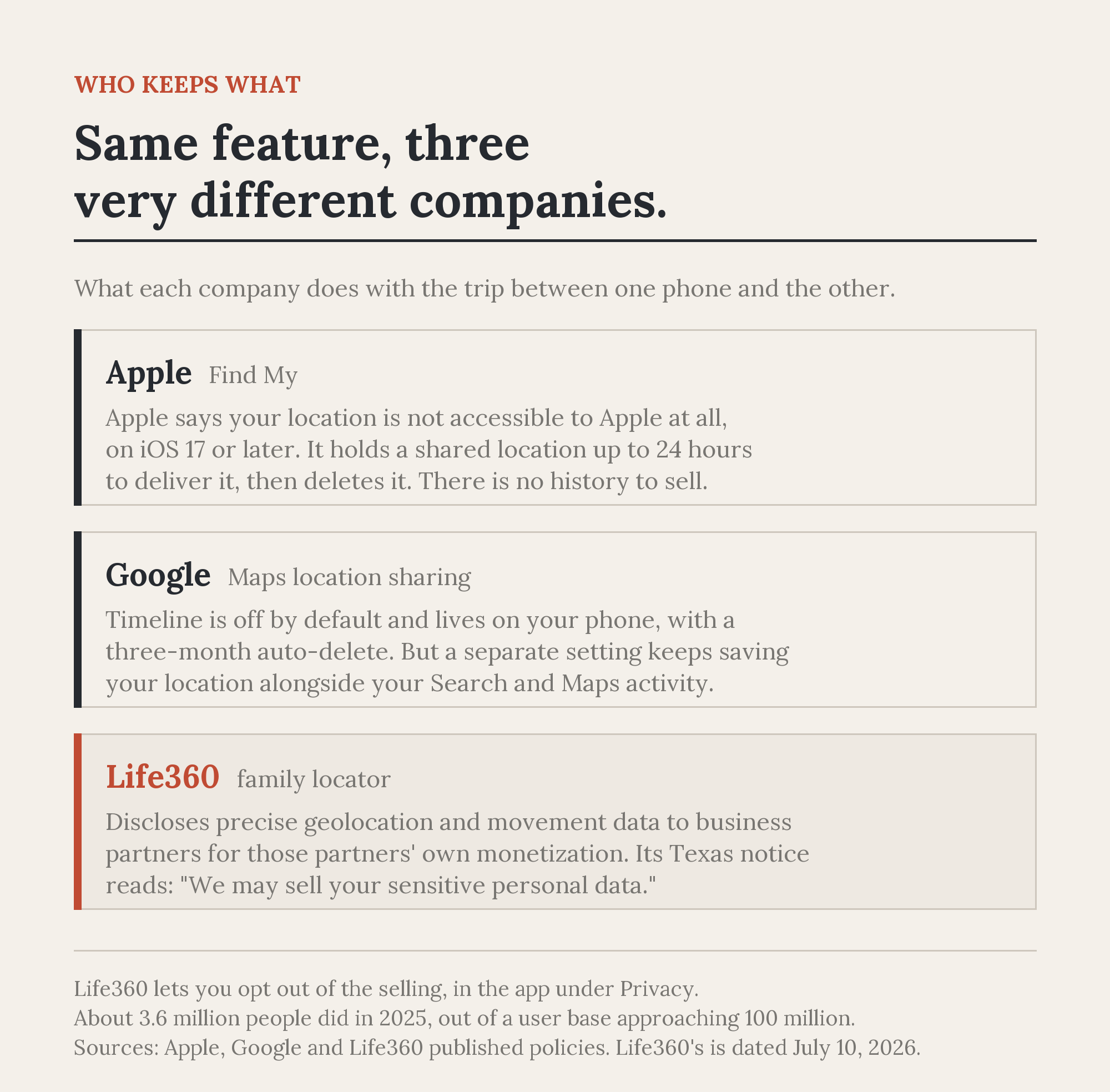
Apple collects the least of the three. If you and the person you share with are both on iOS 17 or later, Apple says your location is not accessible to Apple at all. It holds a shared location for up to 24 hours to deliver the service, then deletes it. There is no history for you to scroll back through, which some people find annoying, but that annoyance is a privacy feature. Apple's own law-enforcement guidelines say it does not have GPS information for a specific device or user. A subpoena aimed at Apple's copy of your family's movements does not give much, because there is not much to give.
There is one default setting to be aware of. When the organizer of a Family Sharing group turns on location sharing, the organizer's location is shared automatically with everyone in the group, and with anyone added to the group later. Everyone else chooses who they share with themselves. The organizer is opted in by being the organizer.
Google Maps sits close by. Timeline, the feature that keeps a record of where you have been, is off by default, so you have to turn it on yourself. Since 2023 the data resides on your phone rather than on Google's servers, with a three-month auto-delete as the default setting.
Turning Timeline off does not mean Google stops recording where you go. It means Google stops building you a map of it. A separate setting, the one that saves your Search and Maps activity, keeps attaching your location to what you look up and where you ask for directions. So a person who turns Timeline off has closed the file they can see and left the one they cannot.
Life360
Life360 is the app built just for location sharing. Almost 100 million people open it every month, about 52 million of them in the United States, and for a lot of American families it is the brand name that stands in for the whole category, the way coke stands in for soda.
Read its privacy policy and you find that Life360 discloses "precise geolocation data, movement data, and other information" about your use of the service to select business partners for those partners' own monetization purposes. That language means advertising. The buyers are ad-targeting companies and the data marketplaces that supply them, and what they want is a pattern. Which stores you walk into, how often, at what hour, and what that suggests about your household. You paid for the map, and the pattern underneath it gets sold to somebody else.
Further down, in the section covering state privacy laws, there is a line printed for Texas residents. Seven words: "We may sell your sensitive personal data."
That is the current policy, updated in July 2026. Here is how it got there.
In 2021, The Markup reported that Life360 was selling precise location on its users to about a dozen data brokers. The company's own financial records showed $16 million from selling location data in 2020, close to a fifth of that year's revenue. Plus another $6 million from its deal with Allstate's driving-data arm, Arity. In January 2022 the CEO said the broker sales would stop, with two exceptions kept on purpose. Arity kept getting precise location. A foot-traffic analytics firm kept getting it too, in aggregate rather than raw.
Then in June 2025, The Capitol Forum reported more than 4,600 Life360 "audience segments" for sale through a data marketplace called LiveRamp. An advertiser could buy their way to people who visit a named chain often, or to households sorted by income, by gender, and by the ages of the children in them. Life360 says no precise location goes to LiveRamp, only groupings like "visitors of brand X." Privacy lawyers argue the identifiers attached to those groupings make that distinction thin.
If that sounds familiar, it is because it is the data broker business, running inside an app you installed on purpose. And the family app is not even the biggest source of it on your phone. In December 2024 the FTC took action against a broker called Mobilewalla, alleging it harvested location out of the ad auctions that run inside free apps, and kept it even when it lost the auction. Your weather app runs those auctions. So does the game on your kid's tablet. Turning off the family app would not touch any of that.
You can opt out of having your data sold. It is in the app, under Privacy, behind a link called "Your Privacy Choices." In all of 2025, about 3.6 million people did, out of a user base approaching 100 million.
And, of course, you cannot run the app without always-on location. That is part of the deal.
Two things in Life360's favor, because they do matter. Its policy says it does not sell or share the personal information of members it knows to be under 18, and it does not show ads in child or teen accounts. And the crash detection people pay for has gotten real help to people in a wreck.
Kids don't get to consent
Between adults this is simple. Everyone agrees or nobody shares.
When children are involved, the situation becomes far less straightforward. A twelve-year-old who does not want to be tracked has no way to decline. COPPA, the federal children's privacy law, covers kids under 13 and puts consent in the parent's hands.
Above that age the law mostly speaks to what companies may do, not to what happens inside a home. The parent decides.
In 2020 teenagers organized on TikTok and buried Life360 in one-star reviews, hoping to get it thrown off the App Store. They had no standing, so they used the only avenue they had. The company responded by talking to them. The CEO went on TikTok himself, and the app got a vaguer location option, built with input from the same teenagers who had been trashing it.
It does not only run downhill, either. One reader told me her eleven-year-old keeps asking to see her mother's location, and keeps getting told no. Most of the girl's friends can already watch where their parents are. There is a generation coming up that expects the dot to point both ways.
What the research does suggest is that how monitoring is administered matters more than whether it is done at all. Monitoring a teenager who has agreed to it is different from monitoring behind their back. The teen safety piece covers the neighboring problem.
I am not a parent, so I do not get a vote here. I do know what fourteen-year-old me would have said about it, and it was not polite. If you are raising one right now, you know things I do not.
When it is not a choice
The same feature that keeps a family coordinated keeps some people trapped. A partner who insists on sharing. Who asks why you stopped at the store. Who notices immediately when the dot goes dark. On paper everyone consented.
If that is your house, the ordinary advice does not apply. The National Network to End Domestic Violence is blunt about it. Some people escalate when they feel they have lost access, so before you remove a tracker or shut off sharing, think through how the other person will react and plan for that. Document what is happening first, if it is safe to. Trust your instincts about being watched.
Advocates do this every day and they do it better than any article. The National Domestic Violence Hotline is 1-800-799-7233, or text START to 88788, or chat at thehotline.org.
Sometimes the dot is doing a text message's job
The most useful thing anyone told me while I was writing this came from a mother of two.
She turned location sharing on for both her kids. Shortly after his sixteenth birthday, her son turned his off and called it an invasion of his privacy. It is still an open discussion in that household. But her actual complaint was not about safety. It was that he is bad at telling her where he is. During the school year, when she was working full time and he was riding the bus, that mattered to her.
So I asked her directly. Would a text have been enough? She said yes. If he told her where he was, it would probably be fine.
That is a different problem than the one these apps are sold to solve. The dot is not doing safety work in that house. It is doing the job a check-in would have done, and it does it without anyone having to say anything out loud. Which is easier, but also means the habit never gets built.
She said one more thing that stuck with me. She and her son trust each other, and she gives her kids a lot of freedom precisely because nobody tracked her at that age. Both of those things can be true at the same time as the monitoring is running. Families don't have to be tidy.
All of which raises a question I did not expect to find an answer to. Does monitoring even work?
Being watched changes people
In 2016 a researcher named Jonathon Penney looked at Wikipedia traffic before and after the Snowden disclosures. He took 48 articles matching terrorism keywords the Department of Homeland Security tracked. He found views dropped about 30 percent afterward and stayed down.
Nobody was arrested for reading about car bombs. Nobody was contacted at all. Nothing happened to any of those readers. They simply learned that somebody might be looking, and it changed what they were willing to be curious about.
That is a country, though, not a home. So I went looking for whether anyone has studied what this does inside a family, and the answer turned out to be yes, and older than I expected.
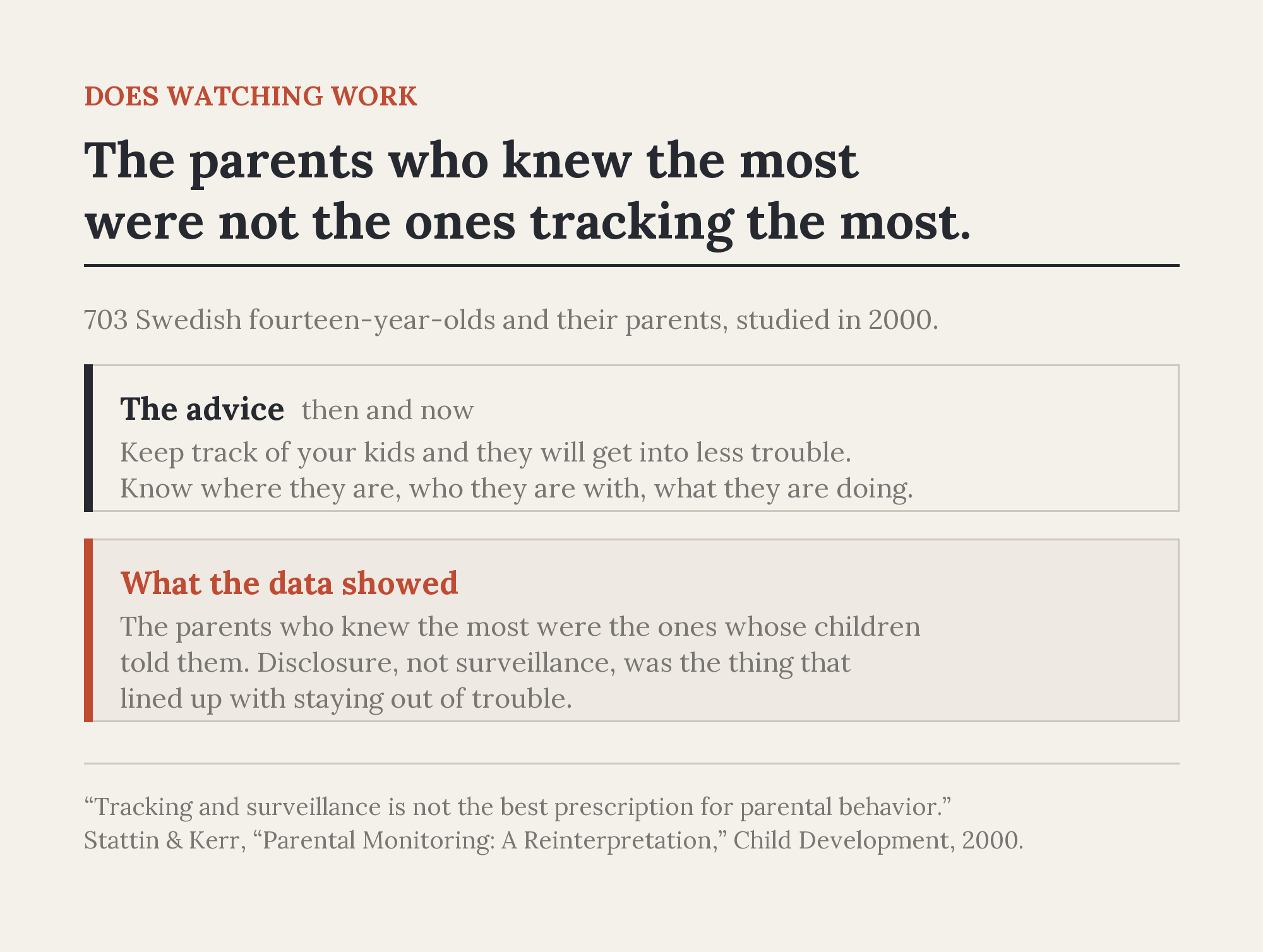
In 2000, two researchers in Sweden named Håkan Stattin and Margaret Kerr studied 703 fourteen-year-olds and their parents. The advice at the time was the same as the advice now: keep track of your kids and they will get into less trouble. What they found was that the parents who knew the most about their children's lives were not the ones doing the most tracking. They were the ones whose children told them. Disclosure, not surveillance, was the thing that actually lined up with staying out of trouble. It held for both sexes and for kids who were and were not already in trouble. Their own conclusion was that "tracking and surveillance is not the best prescription for parental behavior."
What nobody has studied properly is location tracking specifically. A 2024 review in Clinical Child and Family Psychology Review went looking for evidence on digital location tracking in particular. It found that somewhere between a third and two thirds of American families are now doing it. They also found that the research behind it amounts to "much speculation, but minimal data." The reviewers called it a new, common, and vastly understudied parenting behavior. So the dot itself is close to unstudied. The older question, whether watching works better than being told, is not.
I do not think a household is immune to this. Not because families mean any harm, generally they do not, but because the effect does not seem to care much about who is doing the watching. If being watched changes what a person reads under a government, it probably changes something under a parent.
And the Swedish study points the same direction but from the other side. If what actually works is a kid choosing to tell you, then a tool that answers the question without them ever having to say anything might be solving the wrong problem.
What to check
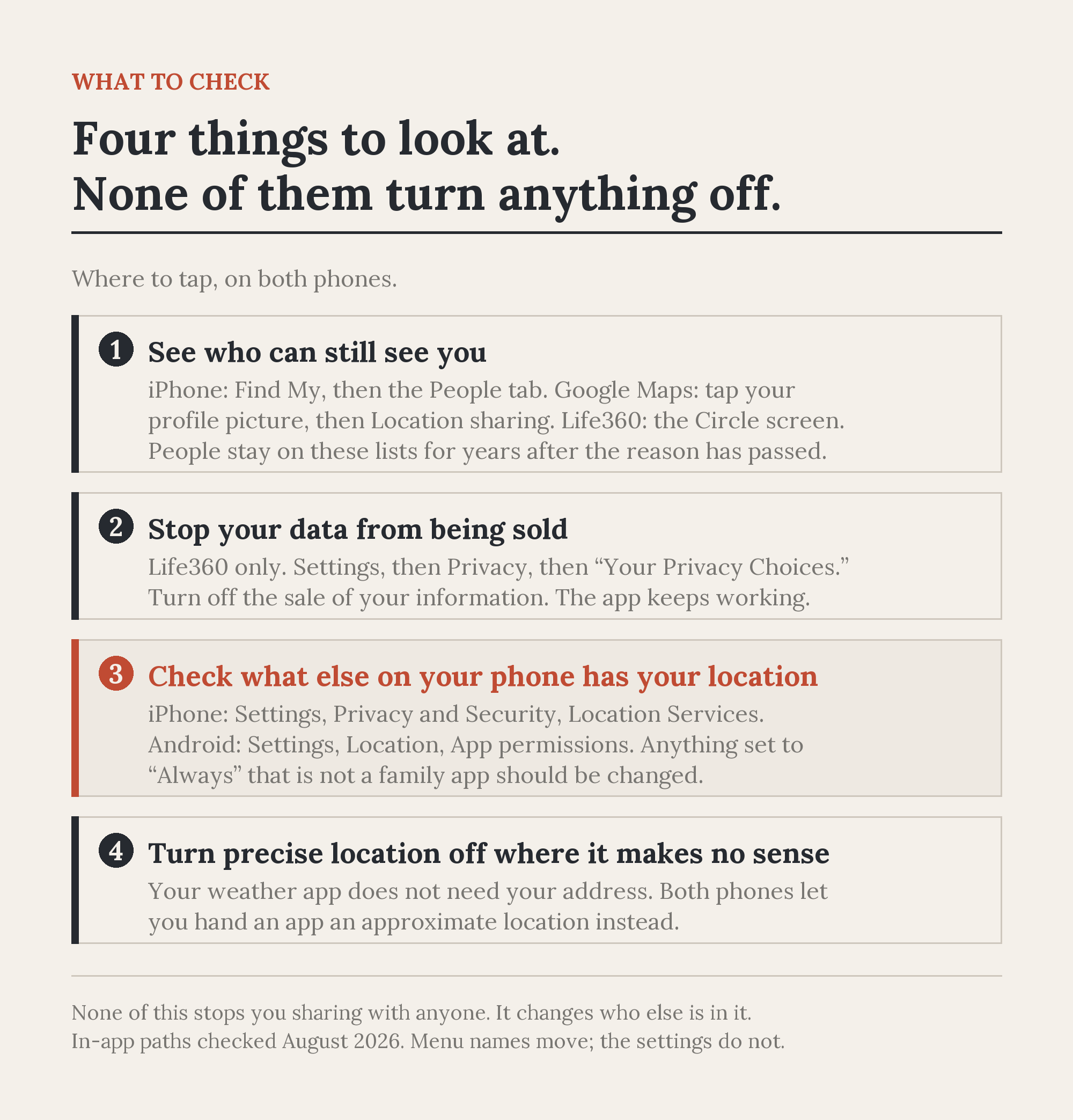
None of these require you to stop sharing anything.
See who can still see you. Open the app you actually use and look at the list.
- iPhone: Find My, then the People tab.
- Google Maps: tap your profile picture, then Location sharing.
- Life360: the Circle screen.
People stay on these lists for years after the reason they were added has passed. An ex. A roommate. A trip you took in 2022.
Stop your data from being sold. If you use Life360, open Settings, then Privacy, then "Your Privacy Choices," and turn off the sale of your information. The app keeps working.
Check what else on your phone has your location. This is where the real volume is, and it is not the family app.
- iPhone: Settings, Privacy and Security, Location Services.
- Android: Settings, Location, App permissions.
Anything set to "Always" that is not a family app should be changed. Most apps do what they need on "While Using."
Turn precise location off where it makes no sense. Your weather app does not need your address. Both phones let you hand an app an approximate location instead.
The question with location sharing isn't whether to turn it off or not. It is which of the three parties are doing what. Your child seeing your location is one arrangement. A company selling the pattern of your Tuesday nights is a different arrangement.
If you use one of these apps, open it and take a look at who is still on your list. Then find out whether the company in the middle is making money off your data.
Sources
- Apple, "Find My & Privacy" (updated December 2025) and "Share your location with your Family Sharing group" (updated December 2025)
- Apple, "Legal Process Guidelines: U.S. Law Enforcement" (October 2025)
- Google, "Updates to Location History and new controls coming soon to Maps" (December 2023); Google Maps Help, "Manage your Google Maps Timeline"; Google Account Help, "Manage your Web & App Activity"
- Life360 Privacy Policy (last modified July 10, 2026)
- Life360, “Life360 Reports Record Q1 2026 Results” (May 11, 2026), for monthly active users
- The Markup, "The Popular Family Safety App Life360 Is Selling Precise Location Data on Its Tens of Millions of Users" (December 2021), and the January 2022 follow-up
- The Capitol Forum, "Life360: Family Safety App Selling Datasets Based on Users' Personal Information on LiveRamp's Data Marketplace" (June 2025)
- FTC, "FTC Takes Action Against Mobilewalla for Collecting and Selling Sensitive Location Data" (December 2024)
- NNEDV Safety Net Project, "Technology Safety Plan"
- Jonathon W. Penney, "Chilling Effects: Online Surveillance and Wikipedia Use," Berkeley Technology Law Journal (2016)
- Stattin H, Kerr M, "Parental Monitoring: A Reinterpretation," Child Development, 2000;71(4):1072-1085
- Davis IS, Thornburg MA, Patel H, Pelham WE, "Digital Location Tracking of Children and Adolescents: A Theoretical Framework and Review," Clinical Child and Family Psychology Review, December 2024;27(4):943-965