Also this week: pricier Amazon devices, a $17 billion Meta settlement, and a check from Disney
Amazon raised the list price on its own devices. Meta settled the teen social media case for $17 billion. Disney owes streaming subscribers a check by September 8. And a gas alarm sold under 18 names on Amazon can stay silent.

I can't write a full piece on everything that happens in tech every week, and you don't have time to read one anyway. So on Fridays I point you at the handful of stories that actually matter to everyday people, tell you in a sentence or two why you should care, and send you to someone who reported it well. Four this week.
Amazon raised prices on the Echo Dot, the Kindle and the Fire TV Stick
Sometime overnight on August 20 the prices on Amazon's own devices changed, with no announcement. Fortune noticed and got a statement out of Amazon: "The consumer electronics industry is facing significant increases in memory and storage component costs. After absorbing these increases for as long as we could, we recently adjusted pricing across our product lines." Memory chips are short because AI data centers are buying them first. Apple and Nintendo have raised prices this month for the same stated reason.
| Device | Old price | New price | On the shelf, Aug 27 |
|---|---|---|---|
| Echo Dot | $49.99 | $79.99 | $54.99, on sale |
| Kindle 16 GB | $109.99 | $149.99 | $149.99, at list |
| Kindle Paperwhite 16 GB | $159.99 | $199.99 | $199.99, at list |
| Fire TV Stick HD | $34.99 | $39.99 | $17.99, on sale |
| Fire TV Stick 4K Max | $59.99 | $84.99 | $49.99, on sale |
| Fire TV Cube | $139.99 | $199.99 | $109.99, on sale |
| Mac mini (Apple) | $799 ($599 at launch) | $899 | orders open, ships Sept 22 |
| Switch 2 (Nintendo) | $449.99 | $499.99 from Sept 1 | $449.99 through Aug 31 |
Amazon prices read off the live listings on August 27. The "new price" is the list price, the crossed-out number next to a sale price.
Look at that last column. The new prices are list prices, and as of August 27 almost none of them is what Amazon is charging. The Echo Dot shows $54.99 with the $79.99 crossed out, five dollars more than the old list. The Fire TV Stick 4K Max is selling ten dollars under its old list. Amazon said in the same statement that it "will also offer promotions across its lineup throughout the year." A higher list price makes every one of those promotions look better. It also raises the floor for the weeks when nothing is on sale. We went through this on laptop price tags on August 26, and here it is on Amazon's own shelf five days later. The same squeeze is coming for phones.
So if the thing you want is on sale, the sale price is real and the crossed-out number is decoration. If it is sitting at list, wait. Amazon told you itself that the promotions are coming.
Sources: Fortune, Apple and Nintendo
Meta agreed to pay $17 billion to settle the teen social media case
Last week's roundup left off with four states in an Oakland courtroom trying Meta on behalf of a 29-state coalition. On August 25 the head of Instagram, Adam Mosseri, was on the stand being shown his own December 2021 blog post, which said more than 90 percent of teens kept the "Take a Break" reminder turned on. The internal number the states put next to it was 1.8 percent of teens actually using it. He agreed that figure was never made public.
The next morning, at about 6 a.m., a settlement was filed. Meta will pay up to $17 billion over ten years to attorneys general from more than 45 states and territories. About $5 billion of that arrives only if YouTube and TikTok adopt the same restrictions. Texas was never in the multistate case and settled on its own the same day, for more than $1 billion, on the same terms. California's share is at least $1.5 billion.
Meta's announcement spells out what changes for anyone under 18 on Instagram and Facebook in the participating states. All of it is on by default:
- a two-hour daily limit that "teens can only turn off with a parent's permission"
- a block from both apps between midnight and 6 a.m.
- notifications muted during school hours, 8 a.m. to 3 p.m.
- a reminder after every 15 minutes of continuous use
- no like or reaction counts, on their own posts or anyone else's
- no cosmetic-surgery or extreme-makeup filters
- the option to make a non-personalized feed the default, and to turn off autoplay
The states' agreement adds two more: a reporting channel where Meta has to answer 90 percent of teens' harm reports within six hours, and an independent auditor. There is also a second, stricter tier. If YouTube and TikTok sign on, the daily limit drops to one hour and the overnight block grows to 10 p.m. through 7 a.m., and that is where the last $5 billion comes from. Meta published an open letter asking YouTube and TikTok to join, on the grounds that "when teens are restricted on one app, they simply move to another." Neither had answered as of August 27.
Judge Yvonne Gonzalez Rogers told the courtroom that morning that a document arriving at 6 a.m. deserved "a closer look." By the afternoon, according to court records reported by NPR and CBS, she had approved the deal. Nobody has said when the restrictions actually switch on. Meta says "pending judicial approval." California says "within months." Neither is a date. Florida stayed out entirely; its attorney general called the money "peanuts" and said, "We'll see them at trial." Zuckerberg never took the stand. Last week's block, if you want the setup.
Sources: California Attorney General, Meta, NPR and The San Francisco Standard
Disney owes YouTube TV and DirecTV Stream subscribers a check by September 8
Disney is paying $50 million to settle a class action called Biddle v. The Walt Disney Company. The suit accused Disney of using its ESPN carriage deals to push up what YouTube TV and DirecTV Stream charged everybody, whether or not they ever watched a game. Disney denies it, and settling means the case ends without a court ever deciding who was right.
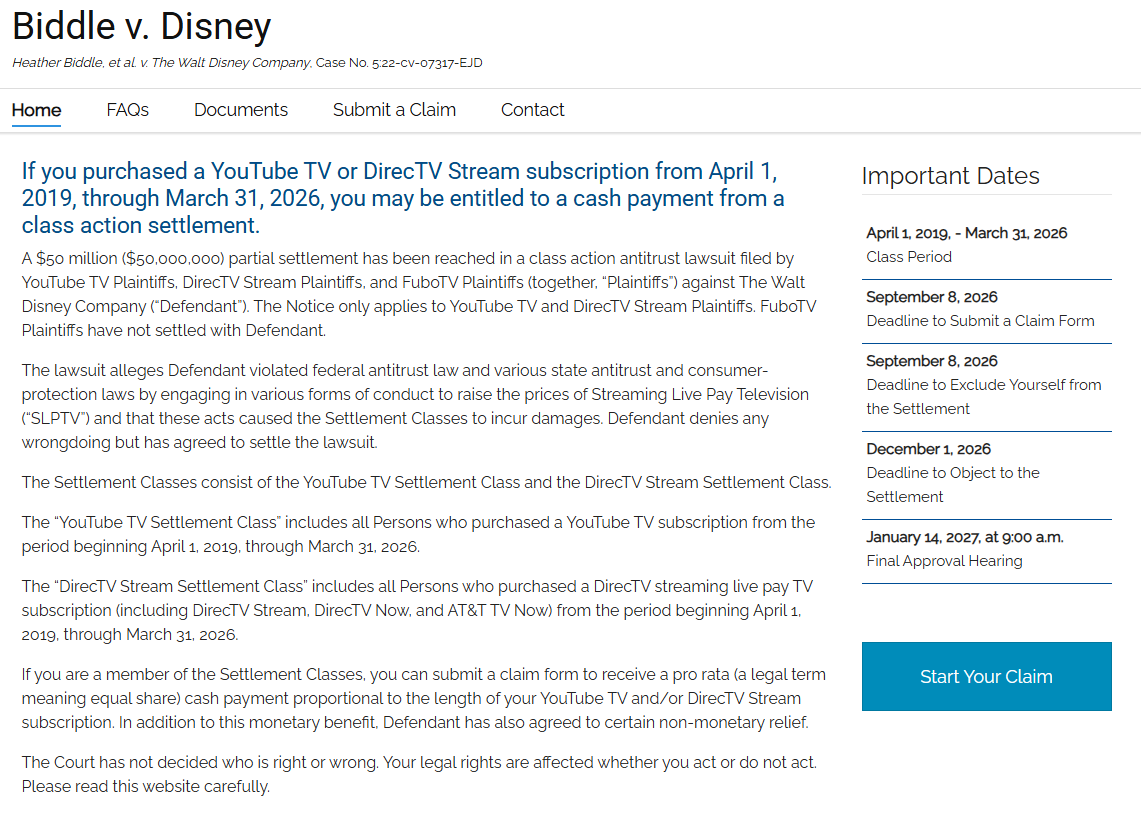
You are owed if you paid for either of these at any point between April 1, 2019 and March 31, 2026:
- YouTube TV
- DirecTV Stream, including the years it was sold as DirecTV Now or AT&T TV Now
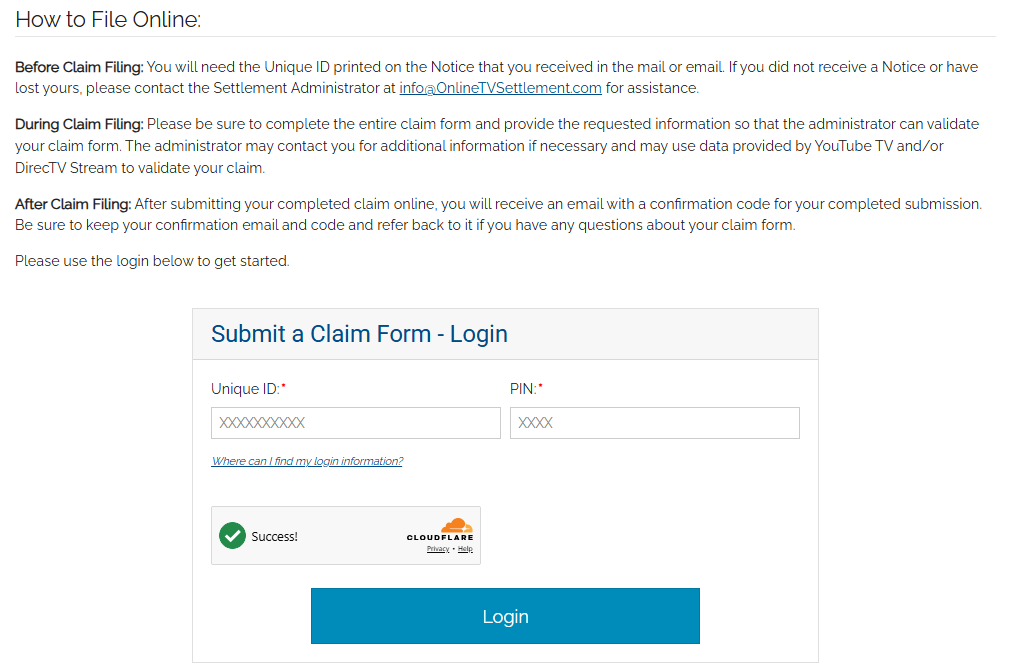
You do not need receipts. The administrator checks claims against the providers' own records. Filing online at onlinetvsettlement.com takes the Unique ID and PIN printed on the notice you got by mail or email. If you never got a notice or lost it, email the administrator at info@OnlineTVSettlement.com and ask. Otherwise you can print the claim form and mail it. Either way, you say how long you subscribed and sign it under penalty of perjury. Payments are pro rata, which means everyone splits the pot in proportion to how long they subscribed, and the size depends on how many people file. Nobody has published a per-person estimate.
Claims are due September 8, 2026. Online is the safer route this close to the deadline, because the mailing instructions say the form has to be in the administrator's hands by September 8, not just postmarked. Then nothing happens for a while. The final approval hearing is January 14, 2027, and money moves only after that and after any appeals. The administrator is Epiq, at 1-877-704-2517, which is a recorded line. Filing is free and there is no fee to release your money, so anyone who asks for one is running a different business.
Source: Online TV Settlement
A gas alarm sold under 18 names on Amazon can stay silent in a real leak
On August 20 the Consumer Product Safety Commission told people to stop using a plug-in natural gas and carbon monoxide detector sold as model KH158. The agency has 91 reports of the unit failing to sound during a real leak. Consumer Reports, which flagged the detector to Amazon back in April, counts four hospitalizations in those reports, two of them children.
About 377,000 were sold between June 2024 and July 2026, for anywhere from $13 to $140, on Amazon, eBay, AliExpress, Micro Center's website and snapklik.com. The maker is a Chinese company called Shenzhen Kanghua Shengshi Industrial, which does business as KH Alert, but you will not find that name on most of the listings. Here is what to check for:
Check for model KH158
- White, gray or black plastic plug-in with a digital display
- A button on the front marked SELF-TEST
- Three lights left of the button: POWER (green), FAULT (yellow), ALARM (red)
Sold under these 18 brand names
- ARIKON
- ELECOIN
- FLUNGSKY
- HAOKESITE
- Hembisen
- JNHCD
- KAKIMENT
- KH Alert
- KOABBIT
- NICGOL
- NORJAN
- OUMEBIU
- Sooguard
- Vilfet
- Vzmcov
- WESHLGD
- XLA Alert
- YOJOCK
This is a warning, not a recall. The manufacturer has not agreed to take the product back, so there is no official refund and no fix coming. CPSC's instruction is to unplug it, throw it away, and put up a detector that meets the UL 2034 standard. Consumer Reports says Amazon pulled the listings, and that if yours came from Amazon you should put it through a return and ask for the refund. We wrote up the difference between a warning and a recall, and this is the case that post was describing.
If you bought a plug-in combination alarm online in the last two years and cannot remember the brand, check your order history for the model number, then look at the front of the unit. Replace it with something carrying a UL mark.
Sources: CPSC and Consumer Reports
That's the week.
If you are new here, Start Here collects the pieces worth reading first, and the Tuesday email carries the whole week in one place.