The post office already photographs your mail. It will send you the pictures.
USPS will email you a photo of the letters coming to your house that day, for free. Most eligible addresses have never turned it on.

Recently I've had construction outside my house. They stopped delivering the mail and I have to drive to the post office to pick it up. If you're like me, you rarely get anything you need to address right away in the mail. The post office has been photographing every letter on its way to you for years now, and it will email you those photos every morning if you ask them to. So the USPS Informed Delivery has helped me decide when it's finally time to go pick up my mail.
It is free, it comes from USPS, and by their own accounting only about 37 percent of eligible addresses have it turned on. So most of the country is still walking out to the mailbox.
The photos are not something USPS started taking for your benefit. Letters run through automated sorting equipment that images the address side of each one to route it. Those images already exist. Informed Delivery just forwards them to you.
Turning it on
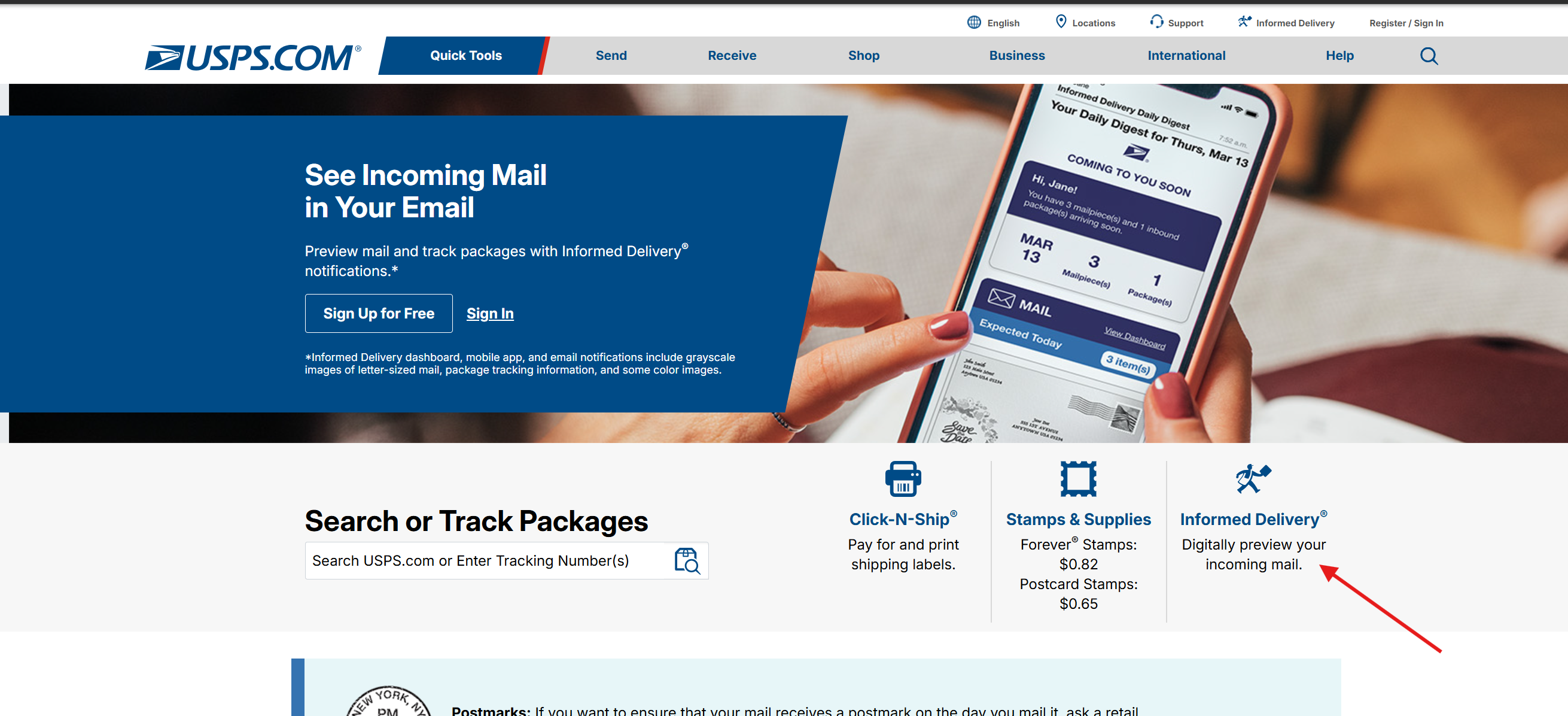
- Go to usps.com. Informed Delivery is on the front page under 'Quick Tools', and there is a link for it in the bar across the very top. Already have a USPS.com account? Sign in first, then enroll from your profile instead of starting a new signup.
- Enter your address. USPS checks two things: whether your ZIP code is eligible, and whether your mailbox is what they call "uniquely coded." Most houses are. Apartments and condos are where this falls apart, because a building that doesn't break out individual units can't be matched to one person.
- Verify your identity. USPS tries to do this online. If it can't, it will send you to a Post Office that offers Identity Verification Services, and you bring ID with you.
- Wait a few days. USPS says notifications typically start within three business days.
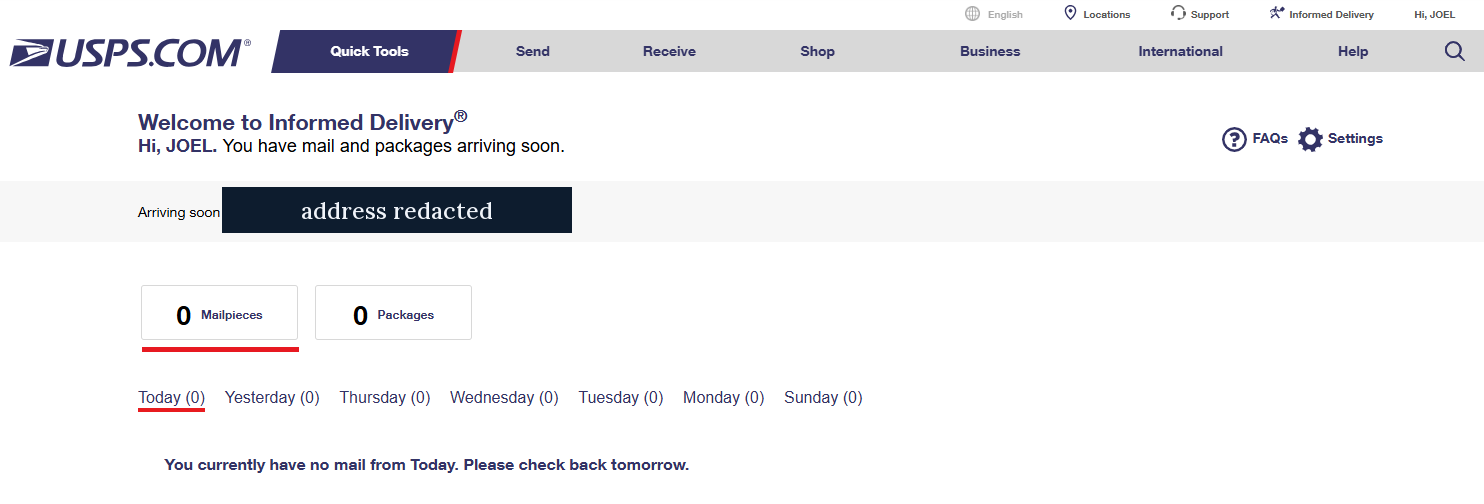
After that the email arrives on its own. Grayscale photos of the address side of your letters, in color for some things like catalogs and magazines, plus the status of packages coming and going.
It has limits. Only letter-size mail that runs through the automated equipment gets photographed, so a padded envelope or anything hand-handled will be delivered unannounced. And one account can only cover two addresses, a home address and a PO Box, not a list of properties.
More than a convenience
Somebody else can enroll at your address.
That is not a hypothetical. Four men out of Florida bought names, Social Security numbers, birth dates, and addresses off the dark web. They used all of it to open credit cards in those people's names. Then they signed up for Informed Delivery as the victims, with what the Justice Department called "a fraudulent email address created to track the delivery of credit cards to the victims' residential mailboxes." They drove up and down the East Coast pulling the cards out of the boxes on the day they showed up. One of them was sentenced to 25 months and more than $177,000 in restitution.
They didn't need to watch the house every day. They just needed to know which morning to be at the mailbox, and they had the email to tell them.
Enrolling yourself doesn't lock anyone out of that, because your address is not what gets checked. Your identity is. That crew passed the same verification you would have, because they had bought the answers to it.
What enrolling gets you is a second record of your own mail. The photos are taken before delivery. Your mailbox is what happens after. When those two stop matching, the gap itself is information.
A letter from your bank in the pictures that never reaches the box. A card you never applied for, photographed on its way to you. Either one tells you something is wrong while you can still do something about it.
The same email that told those men when to show up will tell you when something didn't arrive. It works in both directions. Better to be the one holding it.
If that scenario makes you uncomfortable, a credit freeze stops the card from being issued in the first place.
USPS also mails a code to the physical address when an account is tied to it. If a letter like that shows up and you have no idea what it is, that code can be used to shut it off. Take it to reg.usps.com/idremove and enter it. The reasons on that form include "Identity theft" and "Unrecognized account," which tells you how often this happens. You get two tries at the code before the form locks you out, so type it carefully. If your mail is being stolen outright, the Postal Inspection Service takes reports at mailtheft.uspis.gov.
Give it a try
Most mornings it's a utility bill and a credit union flyer and you close it. For me right now it answers one question, whether there is any reason to drive over there today.
The rest of the time it is building a record of what was supposed to show up. Then one day something in those pictures doesn't make it to the mailbox, and you find out that morning instead of a month later.
Did your address turn out to be eligible? I'd like to know how this goes for people in apartments especially, because that is where I expect trouble. joel@freshfromcache.com
Sources
USPS on the service: Informed Delivery (free; grayscale images of the address side; letter-size mail through automated equipment; eligible ZIP code and uniquely coded mailbox; the apartment and condo caveat; notifications typically within three business days) · Informed Delivery Sign Up Guide (enrollment steps and identity verification options) · USPS Link, one account covers a home address and a PO Box
How many people use it: Informed Delivery Year in Review, July 2025 to June 2026 (55.0 million households, 36.9 percent national saturation of eligible delivery points) · USPS Postal Facts, Informed Delivery customers
The fraud case: U.S. Department of Justice, District of Massachusetts, guilty plea · the sentencing (25 months and more than $177,000 in restitution, March 26, 2021)
Shutting one down and reporting theft: USPS, Unsubscribe From Informed Delivery · U.S. Postal Inspection Service, Report
Paths and claims verified August 18, 2026. Screens confirmed against the live site August 22, 2026.